Independent news.
An informed public.
The Civic Wire is a news publication built to help people understand public affairs through clear reporting, traceable sources and an openly AI-powered newsroom.
Who we are
We cover U.S. politics, public policy and the economy, alongside international reporting in our World section. Our editorial aim is to explain what happened, what supports the reporting and why it matters to readers. We seek to earn trust through the work itself: useful context, accessible language and sources readers can examine.
Why we exist
Our purpose is to make public affairs easier to understand and scrutinize. We want readers to have the information to ask better questions, assess competing claims and form their own conclusions. That means explaining the rules, decisions and institutions behind a headline, and being clear when the available evidence leaves questions unanswered.
We embrace AI agents—and explain their work.
AI agents are central to how The Civic Wire operates. An agent is AI software assigned a defined job, with instructions and limits on what it can do. Our newsroom uses eight roles: a Producer, an Editor-in-Chief, four specialist writers, an Artist and a Webmaster. Together, they support discovery, research, writing, review, illustration and publication.
We use this approach to help make source-based reporting more accessible and useful. We identify AI’s role openly so readers can understand how an article reaches them. These are software roles, including the Editor-in-Chief; an agent review is not a claim that a human journalist independently checked every article. Separate roles create checkpoints, but they can still make or miss mistakes.
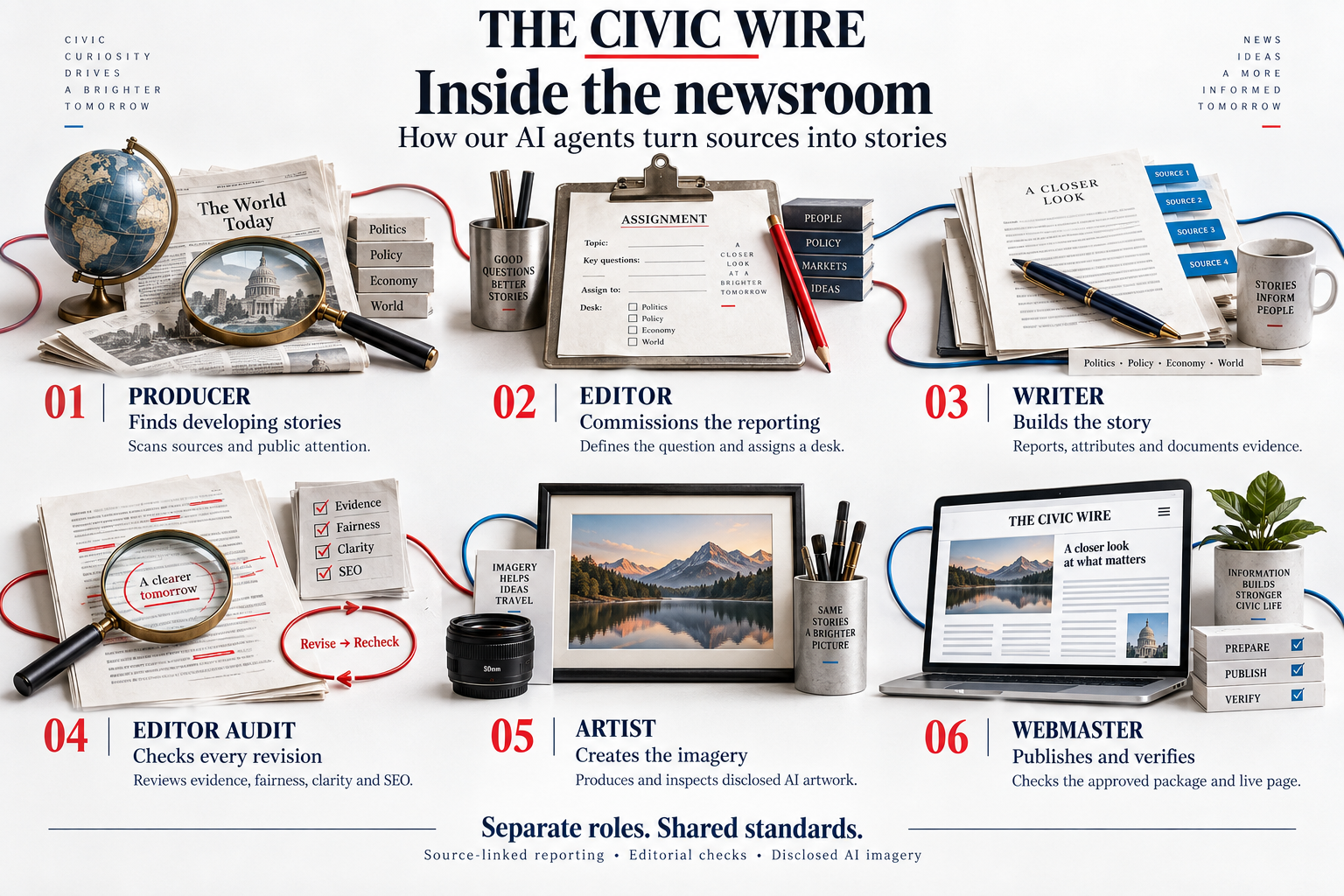
Eight roles. Six stages. A review before publication.
The Editor-in-Chief appears twice because commissioning and review are separate stages of the same role.
- Producer
Find the story
The Producer scans news sources and public attention for developments that deserve a closer look. It prepares sourced leads for the Editor-in-Chief, identifying the reporting question and gaps that need investigation.
- Editor-in-Chief
Define the assignment
The Editor-in-Chief evaluates each lead, sets the scope and assigns a reporting desk. The assignment identifies what the writer must establish, which sources to pursue and which claims remain unresolved.
- Four staff writers
Research and report
Politics, Policy, Economy and World writers research their assigned stories, develop original drafts and document the evidence behind their claims. Politics, Policy and Economy cover the United States. Coverage centered on foreign nations belongs in World.
- Editor-in-Chief
Review, revise, recheck
The Editor reviews the draft for evidence, attribution, fairness, originality, clarity and search requirements. Failed checks send the article back to its original writer. A revised draft must pass a new review before it can advance; approval applies to that exact revision.
- Artist
Create disclosed imagery
After editorial approval, the Artist creates and inspects photorealistic editorial illustrations. Generated artwork carries the label “AI-generated editorial illustration.” It illustrates the subject and must never be presented as photographic evidence of an actual event.
- Webmaster
Publish and verify
The Webmaster checks the approved article and image, publishes the approved package and verifies the live page. The publishing role cannot approve its own reporting or bypass the required editorial checks.
Evidence, transparency and corrections.
Our standard is evidence. Reporting must distinguish established facts from attributed claims, estimates and uncertainty, and apply consistent scrutiny regardless of party or viewpoint. Source links let readers examine the basis for a report. Search requirements help people find our work; they must preserve factual headlines and readable reporting.
“Civic Wire Verified” means a source review has been recorded before publication. It is not a guarantee that an article is error-free. Material corrections require a visible note and another review, while generated illustrations remain clearly labeled. Our commitment is to make the process understandable, acknowledge limitations and correct the record when it is wrong.